Outrageous Predictions
Carry trade unwind brings USD/JPY to 100 and Japan’s next asset bubble
Charu Chanana
Chief Investment Strategist
A Trump-driven Fed pivot crashes the carry trade, hurling USD/JPY to 100 and unleashing Japan’s wild...



Summary: Silver fell 47% from its January high, and SLV now trades near USD 58.55. For an investor who wants the exposure back without committing the full amount, a deep in-the-money long-dated call is one route. It is also a way of paying a crisis-era price for volatility.
A long-dated call can deliver most of a share’s movement for a fifth of the outlay. The question is what is handed over in exchange.
Silver reached an all-time high of USD 121.62 on 29 January 2026. Within six sessions it had lost roughly 47%, trading near USD 64 by 6 February, after the nomination of Kevin Warsh to lead the Federal Reserve and a CME margin increase above 15%. SLV, the iShares Silver Trust, fell 31% in one session, its worst day on record (Source: Saxo, Bloomberg). Past performance is not indicative of future results.
Six months on, SLV closed at USD 58.55 on 11 August 2026, inside a 52-week range of USD 33.85 to USD 109.83 and still higher by roughly 73% over twelve months (Source: Saxo, 11 August 2026). The argument behind the original move has not disappeared: the Silver Institute projects a sixth consecutive annual supply deficit for 2026 (Source: The Silver Institute, silverinstitute.org). An investor who finds that persuasive still faces a practical problem. Committing USD 5,855 to 100 shares of something that has shown it can lose a third of its value in a day is a different decision from agreeing with the thesis.
A call option gives its owner the right, but not the obligation, to buy 100 shares at a fixed price before a set date. When the strike sits well below the current share price, the option tends to behave much like the shares themselves. Delta measures that relationship: it estimates how much the option’s value may change for every USD 1 move in the underlying. A delta of 0.774 suggests roughly 77 cents of movement per USD 1, or about 77 shares of effective exposure. That is the case for a deep in-the-money strike over a cheap out-of-the-money one. A 0.20-delta call is a wager on a particular outcome by a particular date, while a 0.77-delta call is closer to a substitute for the shares.
Important note: The strategies and examples provided in this article are purely for educational purposes. They are intended to assist in shaping your thought process and should not be replicated or implemented without careful consideration. Every investor or trader must conduct their own due diligence and take into account their unique financial situation, risk tolerance, and investment objectives before making any decisions. Remember, investing in the stock market carries risk, and it’s crucial to make informed decisions.
An investor drawn to this structure is, in our view, one who believes the supply argument survives the drawdown and thinks in quarters rather than weeks. That view needs time, hence a January 2027 expiry rather than something in September.
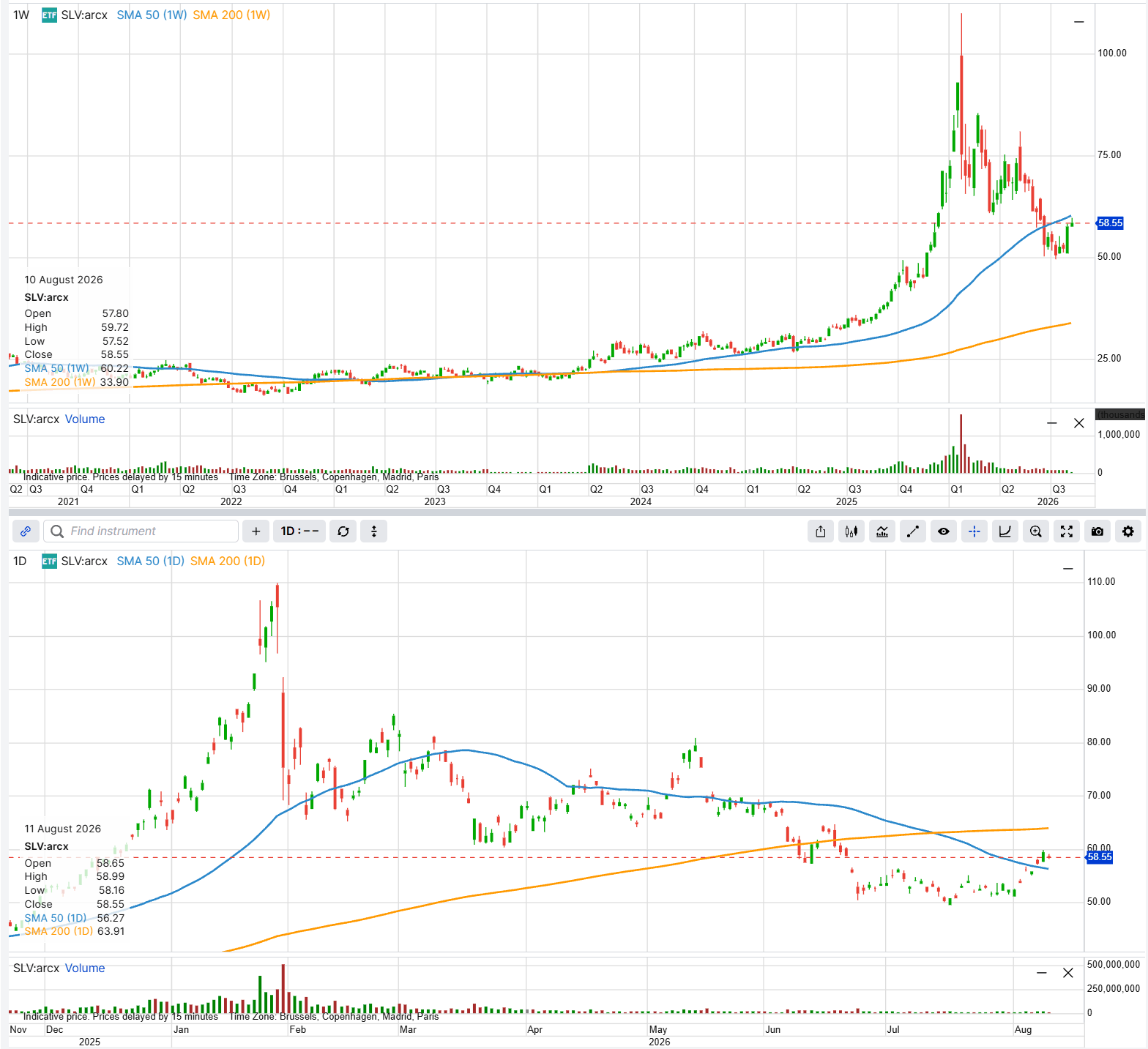 SLV remains far above its long-term average despite the February drawdown. Source: SaxoTrader
This chart is illustrative and for educational purposes only; it is not predictive. Past performance is not indicative of future results.
On the Saxo chain, the SLV 15 January 2027 50 call was offered at approximately USD 11.90 in the 12 August pre-open, with a delta of 0.774 and 47,152 contracts of open interest, the largest of any strike in that expiry (Source: Saxo, indicative pre-open, 12 August 2026). One contract covers 100 shares, and 15 January 2027 is a third Friday, a standard monthly expiry.
The following examples are hypothetical and for educational use only; they are not advice or trade recommendations.
Risk: the maximum loss is the entire debit paid, approximately USD 1,190, which is lost in full if SLV closes at or below 50 at expiry. Costs and charges apply; see Saxo pricing for full details.
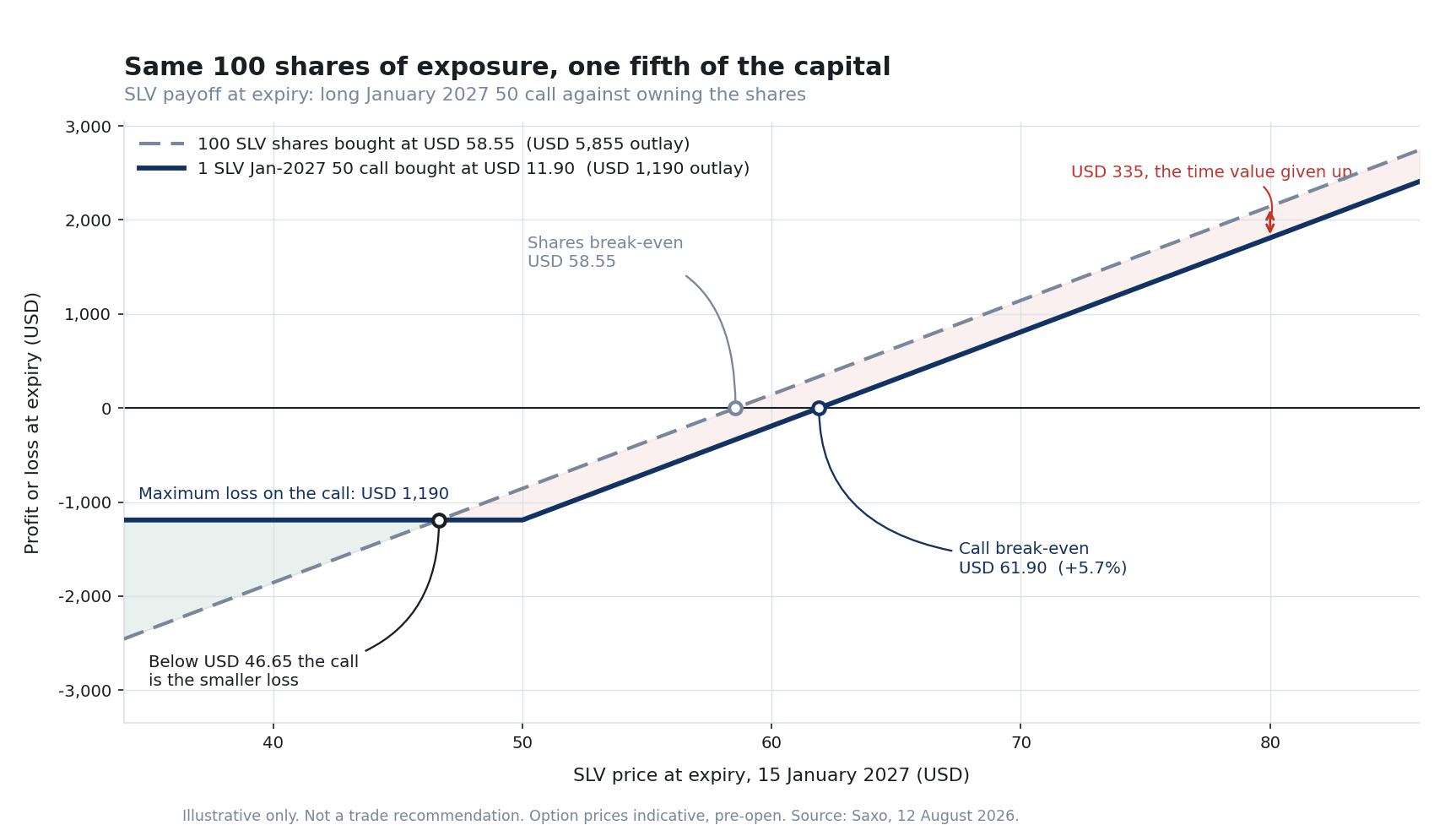 The call gives up a fixed USD 335 above the strike and stops losing below USD 46.65. Source: SaxoTrader]
This chart is illustrative and for educational purposes only; it is not predictive. Figures are modelled at expiry and are not a forecast.
The exchange sits in one figure. Above the 50 strike, the call trails 100 shares by a constant USD 335 at expiry, which is the time value paid at entry and does not grow. In return, the loss stops at USD 1,190 while the shares keep falling, and below approximately USD 46.65 the call is the smaller loss. The investor is buying a floor and paying USD 335 for it.
Strategy insight - leverage is a statement about capital, not about risk. Committing USD 1,190 rather than USD 5,855 caps the worst case in absolute terms, which may suit an investor sizing a speculative position inside a broader portfolio. In percentage terms the position is more aggressive, not less: a move that costs a shareholder 20% could remove the entire premium. The floor is real, and so is the fact that it sits at minus 100%. Illustrative only - not a trade recommendation.
What this looks like in practice (hypothetical, for education only):
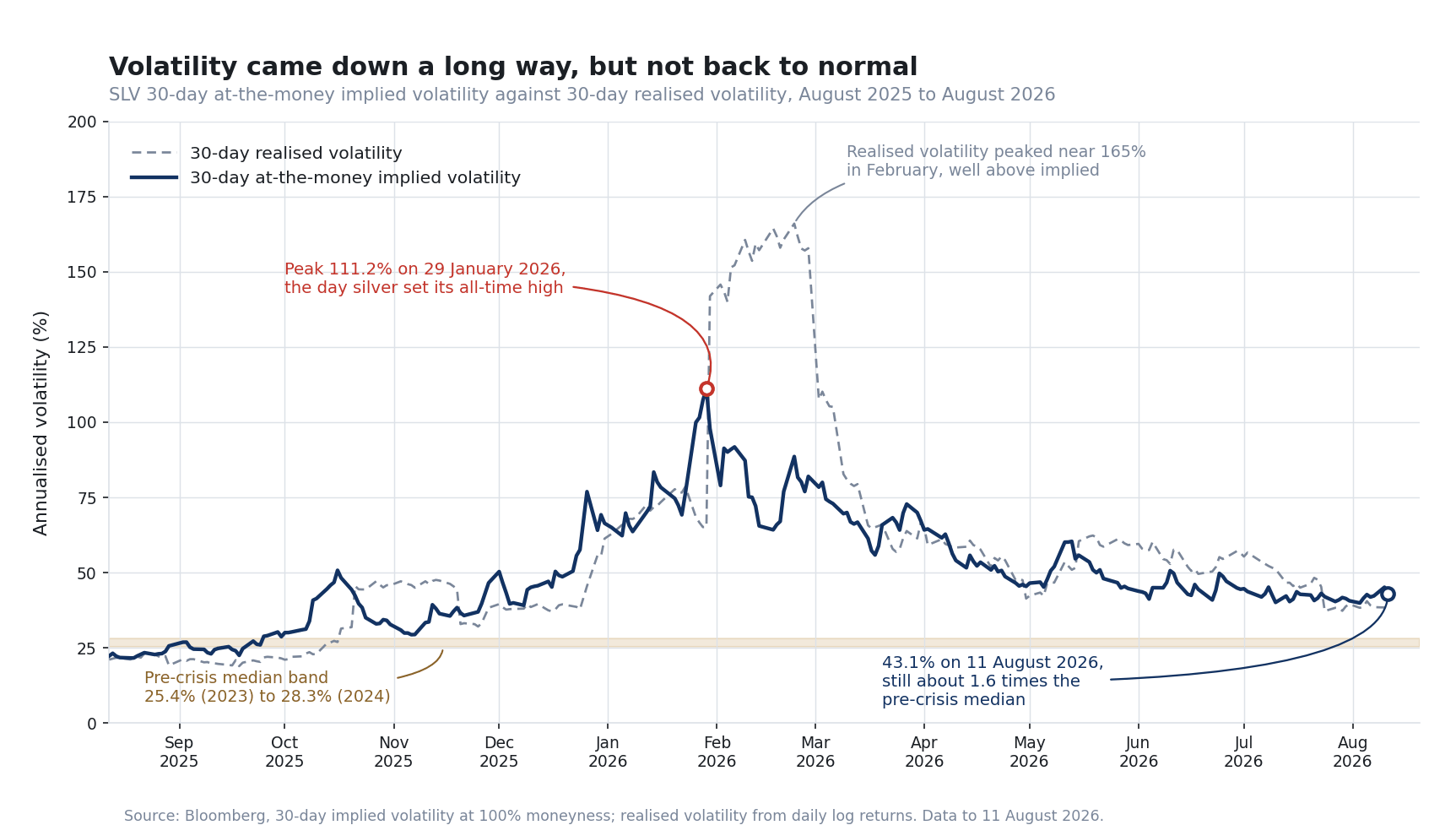 Implied volatility has fallen from 111% to 43%, but remains well above the pre-crisis median. Source: Bloomberg
This chart is illustrative and for educational purposes only; it is not predictive. Past performance is not indicative of future results.
The premium buys time, and it also buys volatility. Vega measures an option’s sensitivity to changes in implied volatility. The January 2027 50 call carries a vega of approximately 0.115, so its value may move by roughly USD 11.50 per contract for each one-point change (Source: Saxo, 12 August 2026). Bloomberg puts SLV 30-day at-the-money implied volatility at 43.14% on 11 August 2026, against medians of 28.27% in 2024 and 25.37% in 2023. A drift back toward that earlier band, with the share price unchanged, could cost roughly USD 170 of the premium.
Measured against what silver is currently doing, the picture is less severe. SLV’s 30-day realised volatility stood at 38.19% on 11 August, only about five points below implied (Source: Bloomberg). In our view the option does not appear obviously overpriced against recent behaviour. It appears priced for that behaviour to continue, which is a different claim, and the one an investor accepts.
Two further points. The 200-day moving average sits at USD 63.91, above the 61.90 break-even, so in our view the position may need the recovery to carry past a level the market has repeatedly failed at since February (Source: TradingView, 11 August 2026). And implied volatility peaked at 111.24% on 29 January, the day of the high, before realised volatility ran toward 165% in February (Source: Bloomberg). The options market did not price the crash in advance, and it cannot price the next margin decision either. That is an exchange policy choice, not a market variable, and no option structure hedges it. Options carry a high risk of rapid loss and are not suitable for every investor.
Everything above assumes the investor wants silver exposure, and that premise deserves testing. February showed the rally to USD 121.62 was carried by positioning and leverage as much as by the supply story, and that one margin decision was enough to unwind it. The deficit was fully intact at the high and did nothing to cushion a 47% fall. A Federal Reserve that keeps real yields elevated has also historically been a headwind for metals that pay no income.
An investor holding that view has no reason to buy a call. Paying USD 1,190 of time value for upside that is not expected is an expensive way to be wrong. The neutral case differs again: someone who already owns the shares and expects a range rather than a recovery may find selling covered calls into the elevated volatility more consistent, accepting a capped upside while retaining the full downside risk of the shares. Costs and charges apply to each leg; see Saxo pricing for full details. Waiting for the volatility regime to settle is also a position, not a failure to act. Illustrative only - not a trade recommendation.
Assignment note: As the buyer of a call you face no assignment risk. Only the seller of an option can be assigned.
A long-dated in-the-money call is not a cheaper way to own SLV. It is a different bargain: less capital committed and a defined worst case, against a fixed amount of time value, a break-even above the current price, and exposure to a volatility level that is high by historical standards. Whether it is worth taking depends on the conviction behind the view and the horizon attached to it, not on the leverage.
Nothing requires holding the position to January 2027. If the thesis changes, the call can be sold in the market like any other instrument. Options give an investor more ways to express a view they already hold. They do not make the view more likely to be right. Options carry a high risk of rapid loss and are not suitable for every investor, and future outcomes are uncertain and may result in losses. Past performance is not indicative of future results.
See Saxo pricing for costs and applicable charges: https://www.home.saxo/rates-and-conditions/pricing-overview
This content is marketing material and should not be regarded as investment advice. Trading financial instruments carries risks and historic performance is not a guarantee of future results.
The Author is permitted to wait at least 24 hours from the time of the publication before they trade the instruments themselves.
The author does not hold positions in any of the instruments mentioned in this article.
The instrument(s) referenced in this content may be issued by a partner, from whom Saxo receives promotional fees, payment or retrocessions. While Saxo may receive compensation from these partnerships, all content is created with the aim of providing clients with valuable information and options.
This content will not be changed or subject to review after publication.
| Related articles/content |
|---|
| Adyen earnings an investors options playbook | 6 Aug 2026 Rheinmetall how to use options on a share that costs EUR 1139 | 31 Jul 2026 Shell into second-quarter earnings two ways to use options for income | 24 Jul 2026 LVMH through results season what mini options change for a smaller portfolio | 22 Jul 2026 Options on leveraged ETFs how investors actually use them | 7 Jul 2026 Adding options to your portfolio what actually changes | 26 Jun 2026 What investors misunderstand about covered calls | 10 Jun 2026 Covered call or cash-secured put | 2 Jun 2026 From shareholder to options user | 26 May 2026 |
| More from the author |
|---|
Outrageous Predictions
Chief Investment Strategist
Outrageous Predictions
Chief Investment Strategist
Outrageous Predictions
Chief Investment Strategist
Outrageous Predictions
Chief Investment Strategist
Outrageous Predictions
Global Head of Investment Strategy
Outrageous Predictions
Investor Content Strategist
Outrageous Predictions
Global Head of Macro Strategy
Outrageous Predictions
Global Head of Macro Strategy
Outrageous Predictions
Saxo Group
Outrageous Predictions
Global Head of Macro Strategy