
CHF
Margin rate


Unlock more buying power with the same capital
Margin financing is available in over 20 currencies
Maintain the freedom to diversify or rebalance your portfolio
Margin rate

Margin rate

Margin rate

Margin rate

Access funds without disrupting your long-term investment strategy. No selling and no missing out on compounding.

Act on strong opportunity without waiting for cash to settle or reshuffle your portfolio. Gives you the agility to seize the moment.

Allows you to build new positions and reduce old ones with minimal disruption and poor timing risk.

Helps you acquire additional shares to enhance yield—especially in low-volatility environments.
| Currency | Classic | Platinum | VIP |
|---|---|---|---|
| CHF | 2.00% | 1.50% | 1.00% |
| JPY | 2.73% | 2.23% | 1.73% |
| SGD | 2.91% | 2.41% | 1.91% |
| HKD | 3.50% | 3.00% | 2.50% |
| USD | 5.65% | 5.15% | 4.65% |
| Without financing | With CHF financing | With SGD financing | |
|---|---|---|---|
Initial capital | SGD 100,000 | SGD 100,000 | SGD 100,000 |
Margin loan amount | - | SGD 100,000 equivalent | SGD 100,000 |
Total market exposure | SGD 100,000 | SGD 200,000 equivalent | SGD 200,000 |
Capital gain if investment rises 8% | SGD 8,000 (100,000 x 8%) | SGD 16,000 (200,000 x 8%) | SGD 16,000 (200,000 x 8%) |
Estimated loan interest | - | SGD 2,000 (100,000 x 2.00% interest on CHF loans for Classic clients) | SGD 2,910 (100,000 x 2.91% interest on SGD loans for Classic clients) |
Estimated return after interest (before FX costs) | SGD 8,000 | SGD 14,000 (16,000 - 2,000) | SGD 13,090 (16,000 - 2,910) |
Return on initial capital | 8.0% (8,000 / 100,000) | 14.0% (14,000 / 100,000) | 13.1% (13,090 / 100,000) |
The clearest way to understand margin lending is to compare the same investment idea with and without financing.
Assume an investor wants exposure to AI and semiconductor stocks, and the investment rises by 8% over the period. The investor either uses only SGD 100,000 of their own capital, or uses SGD 100,000 of their own capital plus SGD 100,000 of margin lending. For illustration, the CHF funding rate is 2.00% p.a. and the SGD funding rate is 2.91% p.a. The example assumes no FX movement, no transaction costs and no change in collateral requirements. Read more >>

Margin lending lets you buy more securities (stocks, ETFs, bonds and stock options) by using the assets in your Margin Lending Account as collateral. This means you can invest in larger positions than what your current cash balance would otherwise allow.
i) If you trade FX, FX options, Futures, CFDs, Mutual Funds or Index Options:
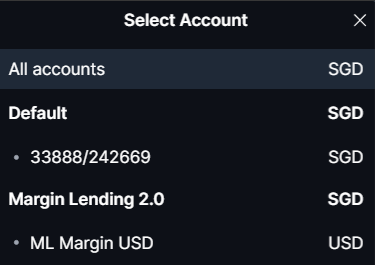
When you enable Margin Lending Account, a separate account (under the same login) called 'Margin Lending 2.0' is set up. Margin Lending 2.0 enables you to use a margin loan to support your trading activities across stocks, ETFs, bonds and stock options. You can also use a margin loan to receive physical delivery of your stock options. To transfer cash products (stocks, ETFs and bonds) from your default trading account to your Margin Lending Account (i.e., Margin Lending 2.0) for use as collateral, please go to Profile> Portfolio Transfer >Sub-account transfer.
ii) If you trade only Stocks, ETFs, Bonds or Stock Options:
When you enable Margin Lending Account, your default trading account is converted into a Margin Lending Account because the products you trade are those supported under the Margin Lending Account service. Your Margin Lending Account enables you to use a margin loan to support your trading activities across stocks, ETFs, bonds, and stock options. You can also use a margin loan to receive physical delivery of your stock options.
If you wish to trade other products (FX, FX options, Futures, CFDs, Mutual Funds or Index Options), please use your default trading account. If you do not have a default trading account, please apply for one by going to My Profile> Request new accounts> Request currency sub-account and choose to create a sub-account under the “Default” group. Trading of stocks, ETFs, bonds and stock options will still be available on your default trading account without the use of a margin loan.
Increased buying power
Margin lending lets you buy more securities (stocks, ETFs, bonds and stock options) by using the assets in your Margin Lending Account as collateral. This means you can invest in larger positions than what your current cash balance would otherwise allow.
If stock A has 75% collateral value, every 100 shares of stock A you purchase allows you to buy 75 more shares using the same amount of eligible collateral in your account. The 75 shares purchased would then offer yet another 75% of collateral, which would allow you to purchase 56 more shares of stock A. Eventually, this collateral offered to your purchased shares will lead you to be able to purchase 400 shares of Stock A.
A quick way to calculate your potential buying power would be:
100 shares / (1-collateral value)
= 100 shares / (1 – 0.75)
= 400 shares.
Potentially higher returns
Scenario 1: Trade with Cash
Assume you invest $15,000 into share A at $1.50 per share. You would be able to purchase 10,000 shares. If you sold all the shares at $1.70, you would receive $17,000. Your gross gain would be $2,000 and your gross return will be 13.33%*.
Scenario 2: Trade with Margin Lending Account
Assume you invest $15,000 into share A at $1.50 per share and share A has a collateral value of 75%. Without margin lending, you will be able to purchase 10,000 shares ($15,000/$1.50). However, with margin lending, you will have 4x buying power, and you would be able to purchase 40,000 shares of share A. If you sold all the shares at $1.70, you would receive $68,000. After returning your loan of $45,000, your gross gain in this scenario would be $8,000 and your gross return will be 53.33%*.
However, you may experience higher losses with leverage.
Scenario 1: Trade with Cash
Assume you invest $15,000 into share A at $1.50 per share. You would be able to purchase 10,000 shares. If you sold all the shares at $1.30, you would receive $13,000. Your gross loss would be $2,000 and your gross return would be -13.33%*.
Scenario 2: Trade with Margin Lending Account
Assume you invest $15,000 into share A at $1.50 per share and share A has a collateral value of 75%. Without margin lending, you will be able to purchase 10,000 shares ($15,000/$1.50). However, with margin lending, you will have 4x buying power, and you would be able to purchase 40,000 shares of share A. If you sold all the shares at $1.30, you would receive $52,000. After returning your loan of $45,000, your gross loss in this scenario would be $8,000 and your gross return will be -53.33%*.
Your buying power is the total value of securities you can buy based on the collateral value of the eligible assets in your Margin Lending Account.
Saxo lets you use some of your eligible assets as collateral to finance and invest in more securities. This increases your buying power, which is based on your cash and the collateral value of eligible assets. Eligible assets include stocks, ETFs and bonds accepted by Saxo in its discretion and in compliance with regulatory requirements. The risk rating of each asset affects its collateral value.
You can find the collateral value of eligible assets under Trading Conditions > Instrument. You can also see the collateral value of a specific instrument on the trade ticket in the platform.
Imagine you have SGD 5,000 in available capital and already have an active Margin Lending Account. You want to buy stock A, which currently offers a 12-month dividend yield of around 5.5%.
With stock A offering 75% collateral value, you can use SGD 5,000 to purchase up to SGD 20,000 worth of stock A. But let’s say you take a slightly more conservative approach and opt for 3x leverage instead - using your SGD 5,000 and borrowing SGD 10,000 via margin lending at a 3% interest rate to buy a total of SGD 15,000 worth of stock A.
Here’s how the math works:
What to watch: the risks
While the math is compelling, margin lending is not free money. Here are a few important caveats:
Finding the optimal leverage to take versus the risks
| 2x | 2.5x | 3x | 3.5x | |
|---|---|---|---|---|
Dividend yield of stock A | 7.98% | 9.22% | 10.46% | 11.7% |
The percentage stock A can fall before a partial stop out | 33.33% | 20% | 11.11% | 4.76% |
| Default Account - Without margin lending | Margin Lending Account - With margin lending |
|---|---|
|
|
The total amount you can borrow depends on the collateral value of eligible assets in your account.
Each eligible asset has a risk rating from 1 (lowest assessed risk) to 6 which is used to determine the collateral value of the asset. As an example, a stock rated 1 can be collateralised for 75% of the market value of the position. You can find the risk rating and associated collateral value of eligible assets under Trading Conditions > Instrument or in the Collateral column available on the platforms.
There are two ways you can fund your Margin Lending Account:
You must keep your 'Margin Loan Utilisation' below 100% in your Margin Lending Account to avoid a 'margin call’. A “margin call” is an automated stop-out where Saxo cancels open orders and closes open positions in your account(s) – (Margin Lending Account and/or default trading account). As the partial stop-out feature is enabled for the Margin Lending Account, Saxo may reduce your positions in your Margin Lending Account in a phased approach during a 'margin call’ to bring your margin loan utilisation back below 100%. You may refer to the summary of relevant risks in relation to partial stop-out here.
Please note that you may experience a margin call on the Margin Lending Account even though it appears you may have sufficient collateral held on your default trading account (and vice-versa) as your Margin Lending Account and default trading account are subject to separate and distinct margin requirements. Refer to < How do I fund my Margin Lending Account? > above for more details.
Yes, margin utilisation is calculated separately for the default account and the Margin Lending Account. In the default account, this is called margin utilisation (for CFD/FX/Futures/Options), while in the Margin Lending Account, this is called margin loan utilisation.
Imagine a scenario where a client has $10,000 in the default account and $10,000 in the Margin Lending Account:
If you trade margin products (CFD/FX/Futures/Options) in the default account, the $10,000 in the Margin Lending Account cannot be used to support the required margins for trading these products.
In a similar way, the $10,000 in the Margin Lending Account can only be used to support the purchase of eligible securities in the Margin Lending Account and cannot be shared with the default account. Collateral in the default account will not support trades in the Margin Lending Account.
If you want collateral in default account to support margin lending trades, you will have to do a sub-account transfer to move the cash and stock positions to the Margin Lending Account. This can be done via the platform under Profile> Portfolio Transfer> Sub-account Transfer for positions and Profile > Sub-account transfer for cash.
When taking delivery of stock options, you must pay for the shares received. If you lack sufficient cash, margin lending enables you to use your existing eligible assets in your Margin Lending Account as collateral to obtain a margin loan to take delivery. This process happens automatically. The options must also be traded in the Margin Lending Account and there must be sufficient collateral in the Margin Lending Account to support the margin loan.
The partial stop-out feature is enabled on the Margin Lending Account. This means that during a margin call, Saxo may reduce your positions to bring your margin loan utilisation back below 100%.
This is done in a phased approach in the following order: