
Access all our platforms from a single account.

Defined risk is not small risk: what the contract multiplier decides

Summary: A 100-point-wide spread on a EUR 1,420 stock is textbook defined risk. It is also EUR 4,000 on one contract. The number that decides which of those you are actually holding is the one nobody looks at.
The standard advice ahead of a company report is consistent and reasonable. Do not buy naked premium into a binary event. Use a spread. Cap the downside. Know the worst case before you enter.
Now apply it. Take a stock trading near EUR 1,420, roughly where ASML closed on 3 August 2026 (Source: Saxo). Buy a 100-point-wide call spread for a net debit of about EUR 40. The risk is defined, exactly as instructed. It is also EUR 4,000 on a single contract. The rule was followed to the letter and the position is still too large for most books to carry through an event.
That gap is worth naming, because it sits in a blind spot. “Defined” describes the shape of the outcome. It carries no information about magnitude. The variable that sets magnitude is the contract multiplier, and almost nobody treats it as a variable at all.
Important note: The strategies and examples provided in this article are purely for educational purposes. They are intended to assist in shaping your thought process and should not be replicated or implemented without careful consideration. Every investor or trader must conduct their own due diligence and take into account their unique financial situation, risk tolerance, and investment objectives before making any decisions. Remember, investing in the stock market carries risk, and it’s crucial to make informed decisions.
The multiplier is a choice, not a constant
Maximum loss on a vertical spread is the width, less the credit, multiplied by the contract size. Traders spend their attention almost entirely on the first two terms. Strike selection, credit received, break-even placement. The third term gets treated as scenery.
It is not scenery. The 100-share contract is a round-lot convention inherited from a period when shares were cheap, and exchanges have been quietly adjusting it ever since. Euronext now lists smaller contracts on twenty-one European names across Amsterdam, Paris, Brussels and Milan.
The clearest evidence that this is a deliberate dial rather than a standard is Lotus Bakeries. The shares closed at EUR 11,160 on 3 August 2026, which would put a 100-share contract at roughly EUR 1.1 million of notional. Euronext lists the mini at one share (Source: Saxo, 4 August 2026). Everywhere else on the list the size is ten.
Nor is the list confined to expensive shares. Capgemini closed at EUR 107.20 and SAP at EUR 164.64, where a full-size contract presents no obstacle at all. In our view that suggests these contracts are better understood as a granularity product than as an affordability fix.
What changes, and what does not
A smaller contract is not a different instrument. Same strikes, same expiry dates, same implied volatility, same delta per share.
That is verifiable rather than assumed. Comparing both ASML roots on the same 21 August 2026 expiry on 4 August 2026, implied volatility matched to two decimals across the strike range and deltas matched to three (Source: Saxo). The pricing surface is identical. Only the multiplier moves.
Which means the earlier example simply rescales. The same 100-point-wide spread, bought at the same EUR 40 debit, carries EUR 400 of maximum risk on a 10-share contract against EUR 4,000 on the standard, with maximum gain of about EUR 600 against EUR 6,000. Identical break-even, identical shape, identical greeks per share.
Vertical call spread – example structure (illustrative only – not a trade recommendation)
- Buy 1 call, sell 1 call 100 points higher, for a net debit of about EUR 40, being roughly EUR 74 paid for the lower strike less roughly EUR 34 taken in on the higher strike
- Maximum risk on a 10-share contract: about EUR 400, against a maximum gain of about EUR 600
- Maximum risk on a 100-share contract: about EUR 4,000, against a maximum gain of about EUR 6,000
- Break-even: identical in both cases, at the lower strike plus the net debit
All figures are hypothetical and for education only. These are American-style options, so a short leg moving into the money may be assigned before expiry, delivering 10 shares rather than 100. The smaller contract reduces the absolute loss, not the probability of incurring it. Options carry a high risk of rapid loss and are not suitable for every investor. See Saxo pricing for costs and applicable charges.
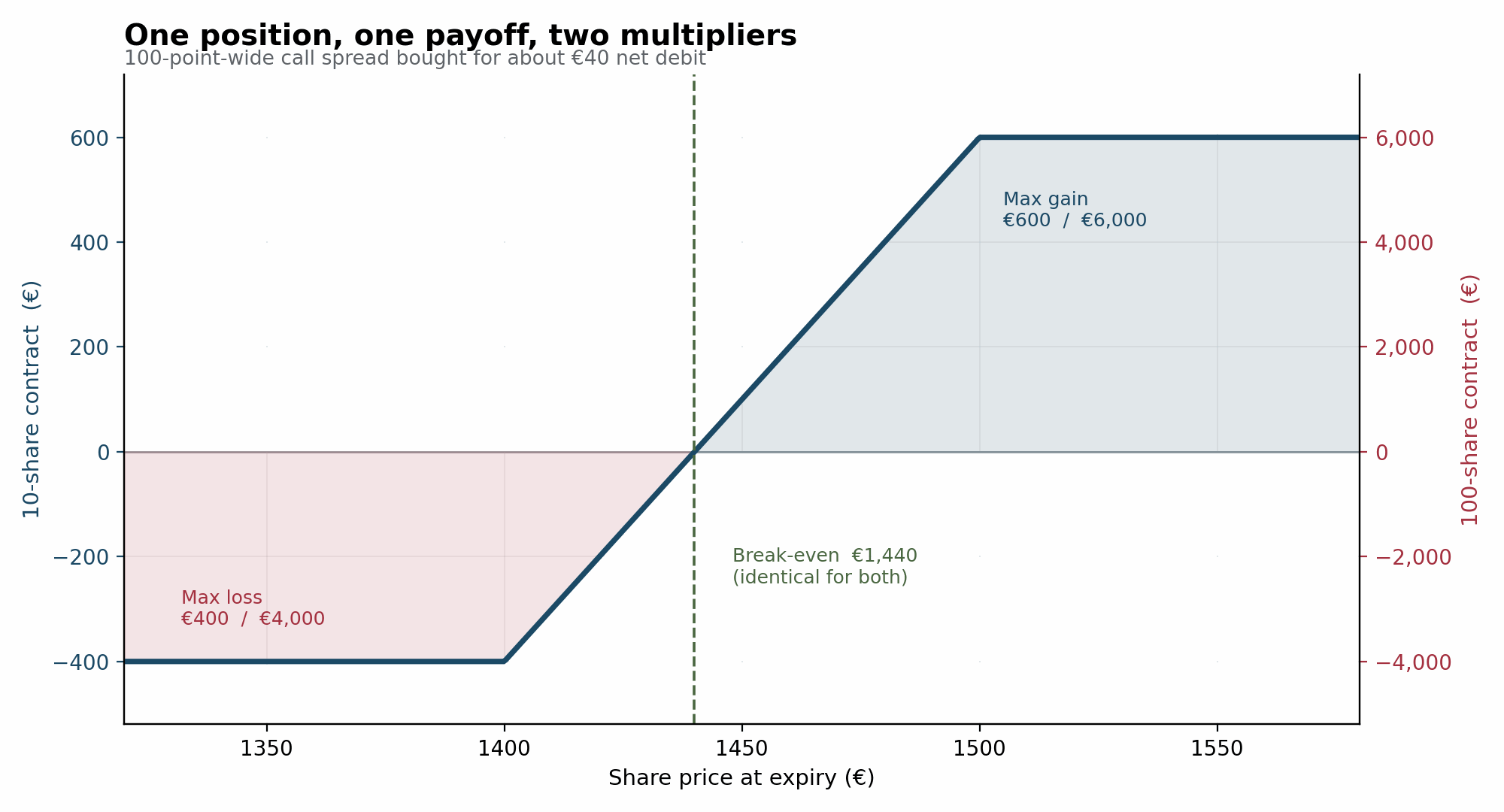 The same position at two contract sizes. Shape, break-even and greeks per share are identical; only the scale changes. Illustrative only, not a trade recommendation. Past performance is not indicative of future results; figures are illustrative and not predictive. Source: Saxo
Why company reports sharpen the problem
Implied volatility rises into a scheduled report and falls afterwards. The practical consequence is that premium per contract is at its most expensive precisely when a trader wants to be involved. The constraint is not constant. It tightens exactly as the opportunity appears.
That collides with position sizing. A risk rule expressed as a percentage of capital sets a maximum bet. The contract sets a minimum one. Where the minimum exceeds the maximum, something has to give, and in practice it is usually the rule rather than the trade.
Strategy insight – repetition is the point. The risk on any single event position is the full defined loss, and a smaller multiplier changes the absolute numbers rather than that exposure. What it may change is how often the position can be taken at all. Report-day outcomes are fat-tailed and largely company-specific, so any edge a process might hold can only show up across repetitions. A structure a trader can afford twice a year behaves like a lottery ticket regardless of how well it was chosen. Options carry a high risk of rapid loss and are not suitable for every investor. See Saxo pricing for costs and applicable charges.
Where the smaller contract is listed
| Company | Mini code | Market | Contract size | Weekly minis |
|---|---|---|---|---|
| Adidas | ADQM | Amsterdam | 10 | no |
| Airbus | EA1M | Paris | 10 | no |
| Allianz | AZQM | Amsterdam | 10 | no |
| argenx | ARGM | Brussels | 10 | no |
| ASM International | ASMM | Amsterdam | 10 | yes |
| ASML | ASLM | Amsterdam | 10 | yes |
| BE Semiconductor | BESM | Amsterdam | 10 | yes |
| Capgemini | CP1M | Paris | 10 | no |
| EssilorLuxottica | EF1M | Paris | 10 | yes |
| Ferrari | RACM | Milan | 10 | no |
| Hermès | HE1 | Paris | 10 | yes |
| Kering | KR1M | Paris | 10 | no |
| L’Oréal | OR1M | Paris | 10 | yes |
| Lotus Bakeries | LOTM | Brussels | 1 | no |
| LVMH | MC1M | Paris | 10 | yes |
| Rheinmetall | RHQM | Amsterdam | 10 | no |
| SAP | APQM | Amsterdam | 10 | no |
| Safran | SM1M | Paris | 10 | no |
| Schneider Electric | SU1M | Paris | 10 | no |
| Thales | HO1M | Paris | 10 | no |
| UCB | UCBM | Brussels | 10 | no |
Contract specifications as listed on Saxo, 4 August 2026. Adyen is listed separately as a standard stock option in Amsterdam but already carries a 10-share contract, so no mini exists alongside it. Past performance is not indicative of future results; figures are illustrative and not predictive.
Three things worth checking first
Costs weigh proportionally heavier. A per-contract charge sits against a tenth of the notional, so the same fee represents roughly ten times the drag. On short-dated structures this can matter more than the spread. See Saxo pricing for costs and applicable charges.
Do not assume the smaller book is the thinner one. It has to be checked at the strikes actually being considered, though the assumption often fails in the unexpected direction. Comparing both ASML roots on 4 August 2026, the mini quoted tighter than the standard contract on fourteen of the twenty lines examined, equal on five and wider on one (Source: Saxo).
Weekly availability is a separate question from size. Only six of the twenty-one names list weekly minis, and that, not the multiplier, decides whether a scheduled event can be isolated in a short-dated contract rather than carried through a monthly. Multi-leg order support also varies by venue: the Milan-listed Ferrari mini does not currently support it at Saxo, so spreads are not available on that root.
Final thoughts
Defining risk is a good habit and none of this argues against it. But a defined loss and a survivable loss are separate tests, and passing the first says nothing about the second.
The multiplier is the term that connects them, and unlike volatility or direction it is not something a trader has to forecast. It is simply something to notice, because on the same underlying it may be available in more than one size.
In our view the more complete question before an event position is not only whether the risk is defined. It is whether it is defined at a size that could be repeated. Options carry a high risk of rapid loss and are not suitable for every investor, and a smaller contract changes the scale of a loss rather than the chance of one.
This content is marketing material and should not be regarded as investment advice. Trading financial instruments carries risks and historic performance is not a guarantee of future results.
Past performance is not indicative of future results; figures are illustrative and not predictive.
The Author is permitted to wait at least 24 hours from the time of the publication before they trade the instruments themselves.
At the time of writing the author holds no position in any of the instruments referenced in this article.
The instrument(s) referenced in this content may be issued by a partner, from whom Saxo receives promotional fees, payment or retrocessions. While Saxo may receive compensation from these partnerships, all content is created with the aim of providing clients with valuable information and options.
This content will not be changed or subject to review after publication.
| More from the author |
|---|