
You can access both of our platforms from a single Saxo account.

Volatility drains, then Nvidia slips after hours - Options Brief - 12 November 2026

Summary: Stocks went their own way on Wednesday and the price of index protection dropped. Then Nvidia fell after the close. Will yesterday's low option prices hold at the open?
An AI-led rally cheapened protection across the volatility curve, then Nvidia fell after the close.
MARKET REGIME: TRANSITIONING | VIX 17.49 | TERM STRUCTURE: CONTANGO | SKEW: ELEVATED (149.09) | FRONT-MONTH VIX FUTURES: 18.800
Today in brief
Wednesday was a day when stocks went their own way and the index still rose. The S&P 500 gained 1.31% to 7,619.38 and the Nasdaq 100 2.28%, led by chipmakers after strong results from CoreWeave, while Microsoft, Meta and Amazon each fell about 2%. Implied correlation, a gauge of how closely options expect stocks to move together, fell 14.84% to 11.76. When stocks offset each other, the index swings less, and in our view that may be why index protection got cheaper: the VIX, which measures what options charge for protection over the next month, fell 10.12% to 17.49, and every cash volatility gauge in our chart fell, with the bond gauge unchanged on the holiday.
Then, after the close, Nvidia fell about 8% on reports that its board was considering the chief executive’s future, and S&P 500 futures traded 0.40% lower by 09:12 CET. The option prices in this brief come from Wednesday’s close, before that move. They put today’s expected move at about 0.56% and the move to Friday’s expiry at about 0.82%, down from 1.21% in Wednesday’s edition and below the 0.99% that one less session alone would have left. In our view those figures may be tested at the open, as the VIX future rose overnight.
Nvidia reports on 17 November. Its options priced a report-day move of about 7.8% at Wednesday’s close, roughly 1.9 times its average move after its last eight reports, before the after-hours fall.
The index has now used 138% of the week’s priced range, above the upper bound, while the VIX sits below its own range. The typical single stock’s volatility rank fell to 31.6 from 37.3, and the flow showed no clear buyer or seller.
That is the whole brief in one read. The sections below hold the detail behind each paragraph, with the charts, the full set of readings and the sources, for when you want to go deeper on one part.
Headline driver
US stocks rebounded on Wednesday as strong results from CoreWeave eased concerns about spending on artificial intelligence, according to the Saxo Market Quick Take. CoreWeave rose 24.7% and Nvidia 2.87%. After the close, Nvidia fell about 8% on reports that its board was considering the chief executive’s future, pulling AI infrastructure stocks and US futures lower.
Rates add a second thread. The US bond market reopens today after Wednesday’s holiday, the two-year Treasury yield trades near 4.77%, and the Quick Take says markets price more than a quarter-point Fed hike for 9 December. The dollar is close to 160 yen.
Market snapshot
- US (Wednesday 11 November close): S&P 500 7,619.38, up 1.31%. Nasdaq 100 28,374.25, up 2.28%. The Dow rose about 0.5% and the equal-weighted S&P 500 0.82%. The semiconductor fund rose 4.82% and the technology fund 3.23%, while Microsoft fell 2.26%, Meta 1.97% and Amazon 1.74%.
- Europe (Wednesday close): the Stoxx 600 rose about 0.7% to a record close and the DAX 1.20% to 26,662.77, with Siemens Energy up 10.8% on record annual results.
- Asia (Thursday, 09:12 CET): the Hang Seng was down 1.26%, the Hang Seng Tech index 2.36% and the Kospi 0.61%.
- Commodities and rates: Brent traded at 93.38 and WTI at 87.04. Gold futures traded at 3,963.8, down 0.92%. The two-year Treasury yield traded at 4.77% and the ten-year at 4.99%. S&P 500 futures were 0.40% lower and Nasdaq 100 futures 0.83% lower.
- Market regime: transitioning, with the VIX at 17.49, the curve in contango and SKEW elevated at 149.09.
Index levels and volatility readings from the watchlist export taken at 09:12 CET on 12 November 2026, which carries Wednesday’s US closes and Thursday’s overnight and early European trading; the Stoxx 600 move, the Dow move, Siemens Energy, CoreWeave and policy context from the same-morning Saxo Market Quick Take. Past performance is not indicative of future results. Source: Saxo, Bloomberg, CBOE.
Volatility surface
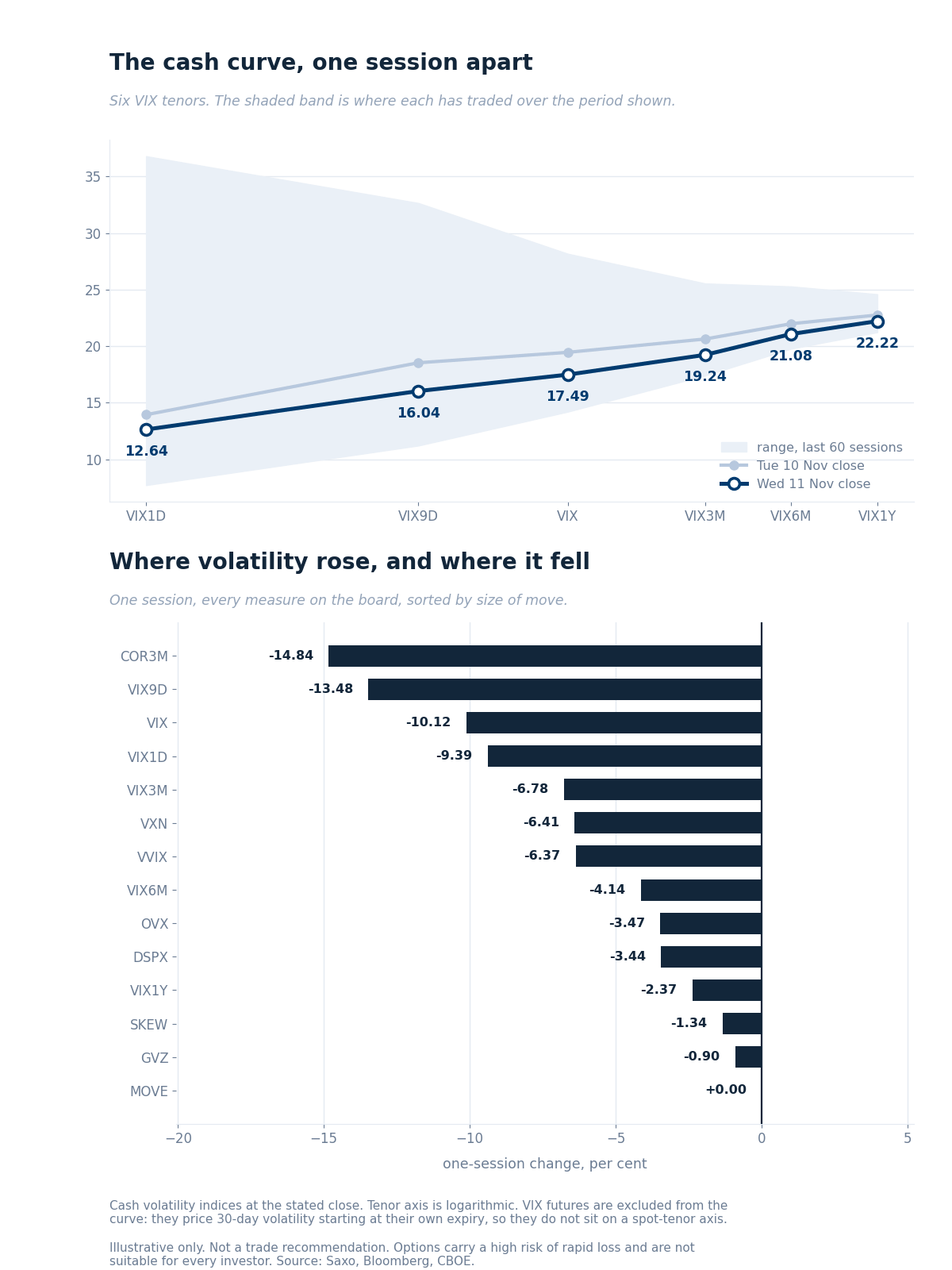
The cash curve at Wednesday’s close against Tuesday’s, over each tenor’s 60-session range, with the one-session change across every measure. Illustrative only. Past performance is not indicative of future results. Source: Saxo, Bloomberg, CBOE.
The whole curve moved down, the front most. The nine-day gauge fell 13.48% to 16.04 and the one-day 9.39% to 12.64, while the one-year eased 2.37%. The VIX at 17.49 now sits close to its median of 16.34 in our store. MOVE, the Treasury volatility gauge, shows no change at 92.44 because the bond market was closed. VIX futures stay off the chart, since each prices a month from its own expiry.
Ratios. VIX3M/VIX rose to 1.10 from 1.06, a steeper curve. VXN/VIX rose to 1.53 from 1.47: Nasdaq volatility runs more than 9 points above the broad gauge.
VIX futures. November trades at 18.80 and December at 19.53. A parity check on the 18 November options, quoted from Wednesday’s close, reads 18.12; the future rose about 0.4 in overnight trade, so we draw no session comparison.
Tails and correlation. SKEW eased 1.34% to 149.09, above its 145.95 median. Implied correlation fell to 11.76 against a 10.52 median.
Single-name volatility
Single-name volatility fell almost across the board. On a common set of 521 underlyings the median implied-volatility rank fell to 31.6 from 37.3, and the mean to 34.9 from 39.6, with 454 names down and 62 up. Names at a rank of 80 or more halved to 14 from 28.
Both regions fell. The US median dropped to 36.8 from 44.7 and the euro-zone median to 28.3 from 32.3.
The index measures above fell, and the index funds fell further than most stocks. The S&P 500 fund’s rank dropped to 20.6 from 31.3 and the small-cap fund to 13.6 from 21.2, while the Nasdaq 100 fund fell to 50.0 from 60.4 and the semiconductor fund to 53.9 from 66.3. Nvidia fell to 77.0 from 95.9 and Meta to 43.5 from 48.5, while Microsoft barely moved at 31.9. The long-dated Treasury fund was one of the few risers, at 45.3 from 43.7.
Implied-volatility rank from the Saxo screener, read at about 09:15 CET on 12 November 2026, carrying Wednesday’s close and not the after-hours move, against the reading carrying Tuesday’s close. Source: Saxo.
Options flow sentiment
Based on end-of-day Wednesday 11 November, yesterday’s positioning, not today’s price action.
- Single-name flow leaned to calls in chipmakers, Microsoft and Meta, though most of it carried no clear buyer or seller, and little protection was added in the mega-caps that fell.
- Sector and ETF flow was mixed and largely financing-related, with no clear direction.
Where the week's range sits
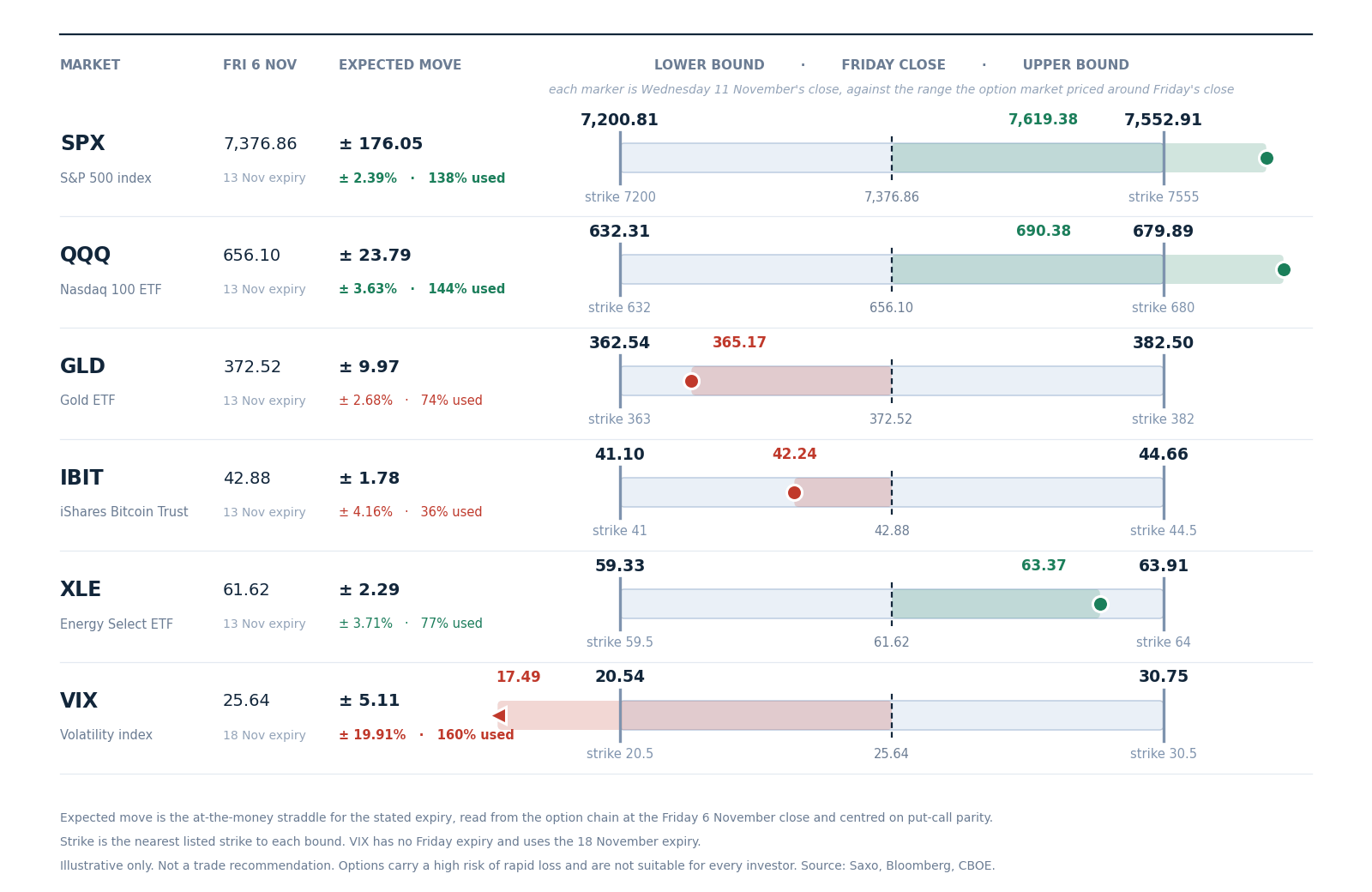
The range the option market priced for this week around Friday 6 November’s close, with each marker at Wednesday 11 November’s close. Illustrative only, not a trade recommendation. Past performance is not indicative of future results. Source: Saxo, Bloomberg, CBOE.
The S&P 500 started the week with 176.05 points, about 2.39%, priced around Friday’s 7,376.86 close, from 7,200.81 to 7,552.91. Wednesday’s close at 7,619.38 sits above the upper bound, so the index has used 138% of its range, up from 82% after Tuesday. The Nasdaq 100 fund has used 144%.
The VIX sits furthest outside its range. It closed at 17.49, well below the 20.54 lower bound of its 18 November range, so it has used 160%. The gold fund has used 74% to the downside, the energy fund 77% to the upside and the bitcoin fund 36% to the downside. These markers predate Nvidia’s after-hours fall.
Options carry a high risk of rapid loss and are not suitable for every investor. Costs and charges apply and vary by account and venue; check the rates applicable to you.
Today's catalysts
- Today: the US bond market reopens; 14:30 CET US jobless claims; 16:00 CET existing home sales; 18:00 CET a 30-year Treasury auction; Fed speakers through the day, Hammack, Barr and Williams among the voters.
- Earnings today: Cisco and Applied Materials after the US close; Siemens, Allianz, Enel and Merck.
- This week: US October producer prices and euro-zone growth data on Friday; Nvidia reports on 17 November.
Earnings scorecard
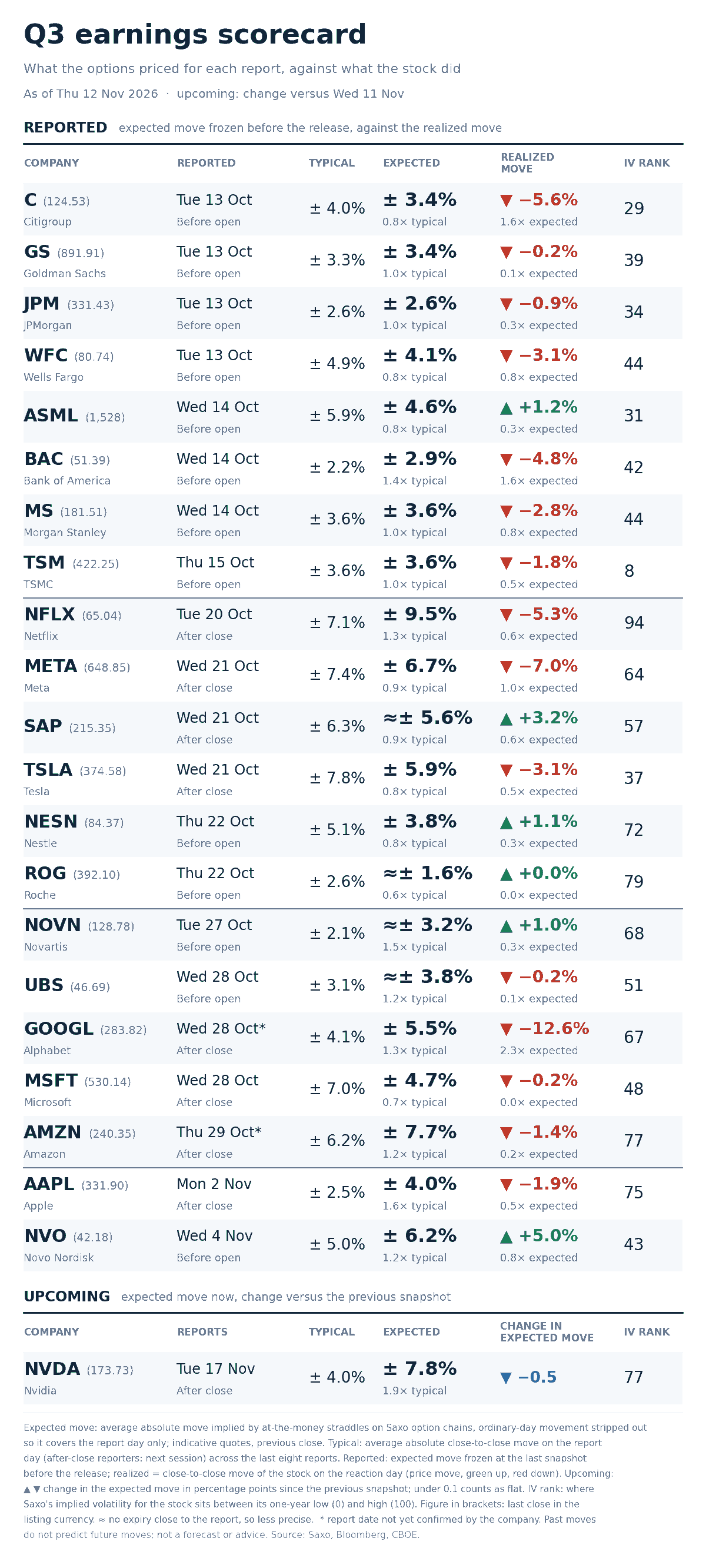
Option-implied expected move for each report day against the stock’s average move after its last eight reports, across the twenty-two names tracked this season. Past performance is not indicative of future results. Source: Saxo, Bloomberg, CBOE.
Nvidia is still the one upcoming name. At Wednesday’s close its options priced a report-day move of about 7.8% for 17 November, 1.9 times the 4.0% it has moved on average after its last eight reports, and down 0.5 points from 8.3% a session earlier. Its last four report-day moves were 3.1%, 5.5% and 1.8% lower and 8.7% higher.
That reading predates the after-hours fall of about 8%, which on its own is close to the report-day move the options were pricing. In our view the next reading may show whether the market adds premium for the leadership question on top of the report.
The other twenty-one names have reported and their board is unchanged. Four moved at least as much as priced: Citigroup, Bank of America, Meta and Alphabet.
Options carry a high risk of rapid loss and are not suitable for every investor. Costs and charges apply and vary by account and venue; check the rates applicable to you. Past performance is not indicative of future results.
What the market is pricing
- Session implied range: S&P 500 options priced about 43 points, 0.56%, for today’s expiry at Wednesday’s close, before Nvidia’s after-hours fall. The one-day gauge at 12.64 implies about 0.80%, a one-standard-deviation figure, a different measure from the expected move above.
- Week ahead: the 13 November expiry prices about 62 points, 0.82%. Wednesday’s edition quoted 91 points, 1.21%, for the same expiry from the same chain. Time alone would have left about 74 points, 0.99%, so in our view implied volatility itself may have come down again. Netting out today leaves about 0.60% for Friday.
- Correlation read: implied correlation fell 14.84% on a day when chipmakers and three mega-caps moved in opposite directions. In our view that may suggest the market is pricing stock-specific moves rather than one move for the whole index.
- Tail read: SKEW eased but stays above its median, and Nvidia’s report-day pricing sits at about 1.9 times its history. In our view that may suggest protection is being kept on the tail and on single names rather than on the index as a whole.
In our view the first test may be today’s open, where Wednesday’s low option prices meet Nvidia’s overnight fall, with jobless claims and the 30-year auction still to come. Options carry a high risk of rapid loss and are not suitable for every investor. Costs and charges apply and vary by account and venue; check the rates applicable to you. Past performance is not indicative of future results.
| More from the author |
|---|