Outrageous Predictions
Executive Summary: Outrageous Predictions 2026
Saxo Group
Saxo Group
Read Saxo's Outrageous Predictions for 2026, our latest batch of low probability, but high impact ev...



Markets don’t reward the same exposures every quarter. Multi‑asset investing is less about chasing returns and more about building a portfolio that can behave through different regimes, especially when drawdowns test decision‑making.
Looking at aggregated Saxo client activity over the past five years, clients who used more than one product type were more likely to have higher profitability outcomes than clients who only used one (for example, stocks only).
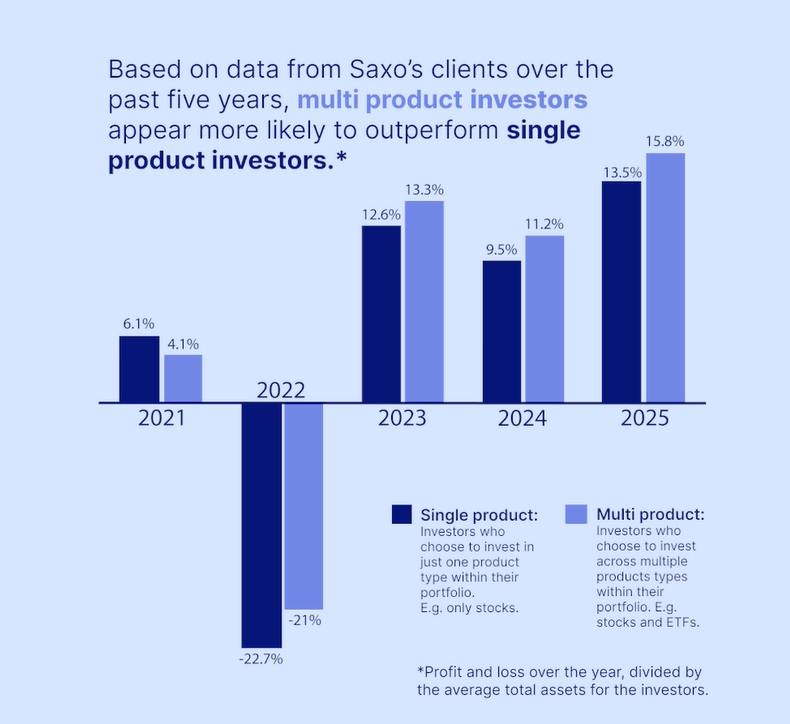
Note: Past performance is not indicative of future results.
Source: Saxo client data
This is an association, not proof that using multiple products causes better results. Clients who use more instruments may differ in experience, risk management, time horizon, trading frequency, and costs—each of which can influence outcomes.
The practical takeaway is simpler: having more than one tool can give investors more ways to respond to changing market regimes—and may reduce the odds that one “single story” dominates results.
Why this may be happening
1) A smoother ride can improve behaviour
When outcomes are less dominated by one market move, investors are often less likely to panic‑sell, overreact, or abandon a plan after a drawdown.
2) Different environments reward different exposures
Stocks don’t lead every quarter. Adding other building blocks (like bonds or bond ETFs) may help when leadership rotates.
3) Less hidden concentration
“Stocks‑only” portfolios often drift into concentrated bets (a few mega‑caps, one sector, one region). Adding another product type can reduce single‑story risk.
4) More consistent habits
ETFs and recurring contributions can encourage steadier investing behaviour. Securities lending can add a supplementary return stream without changing core holdings. These habits are often more important than perfect timing.
Myths that keep investors stuck
Myth 1: “Diversification means lower returns.”
Diversification can reduce extremes, both on the highs and lows. For many investors, the bigger benefit is avoiding deep drawdowns and the bad timing decisions they often trigger.
Myth 2: “ETFs are just beginner products.”
ETFs are simply a wrapper. They can express broad markets, quality, dividends, sectors, regions, or themes—without relying on single‑stock outcomes.
Myth 3: “Bonds don’t matter anymore.”
Bonds are less about excitement and more about ballast. They may help cushion equity volatility and provide liquidity when markets are stressed.
Myth 4: “Securities lending is only for institutional investors.”
A growing number of retail investors use securities lending to generate incremental income on long‑term holdings. It doesn’t change market exposure but can slightly improve portfolio efficiency. (Still carries risk.)
If you’re stocks‑only: common starting points investors consider
A broader toolkit doesn’t have to mean a full rebuild. The examples below are educational illustrations of how investors sometimes introduce a second return driver or a shock absorber. They’re not investment advice and may not be suitable for everyone.
What it does: ETFs can reduce reliance on a handful of stocks by spreading exposure across more companies, sectors, or regions—while still keeping equity exposure.
Simple ways to start (illustrative):
Reality check: ETFs still carry market risk and can fall materially in a broad selloff.
2) Bonds (potential shock absorber / liquidity sleeve)
What it does: Bonds and bond ETFs are often used as ballast and liquidity—particularly when equity volatility rises.
Simple ways to start (illustrative):
Reality check: Bonds can lose money (especially longer duration) and may not hedge equities in every regime.
What it does: Securities lending can provide an additional income stream by lending out shares you already hold, without changing your overall market exposure.
Simple ways to start (illustrative):
Reality check: Securities lending involves counterparty and collateral risks and does not guarantee income.
Risks and reality checks
Bottom line
The big takeaway from Saxo’s own client data is simple: portfolios with more than one way to work may be more resilient, and resilience often supports better outcomes.
If you’re stocks‑only, you don’t need a complicated overhaul. Common examples investors sometimes explore include:
starting with an ETF, considering bonds or bond ETFs, or using securities lending to enhance efficiency of long‑term holdings.
This content is marketing material and should not be regarded as investment advice. Trading financial instruments carries risks and historic performance is not a guarantee of future results.
The instrument(s) referenced in this content may be issued by a partner, from whom Saxo receives promotional fees, payment or retrocessions. While Saxo may receive compensation from these partnerships, all content is created with the aim of providing clients with valuable information and options..
Outrageous Predictions
Saxo Group
Outrageous Predictions
Chief Investment Strategist
Outrageous Predictions
Global Head of Macro Strategy
Outrageous Predictions
Chief Investment Strategist
Outrageous Predictions
Global Head of Investment Strategy
Outrageous Predictions
Global Head of Investment Strategy
Outrageous Predictions
Investor Content Strategist
Outrageous Predictions
Global Head of Macro Strategy
Outrageous Predictions
Global Head of Macro Strategy
Outrageous Predictions
Chief Investment Strategist