Understanding the iron condor option strategy

Understanding the iron condor option strategy

Saxo Be Invested

Saxo Group

If you think the term "iron condor" sounds more like a mythical creature than an investment strategy, you’re not alone. However, while it may seem exotic, this strategy is surprisingly straightforward once broken down. Let’s explore how this strategy works, why traders use it, and how it could fit into your futures trading toolkit.

What is an iron condor?

An iron condor is a neutral options strategy that involves four options contracts:

  • Sell a lower-strike put option.
  • Buy a lower-strike put option (further out of the money).
  • Sell a higher-strike call option.
  • Buy a higher-strike call option (further out of the money).

These options are based on the same underlying asset, such as Crude Oil futures, and share the same expiration date.

Together, they form two spreads:

  • A bull put spread (to limit risk on the downside).
  • A bear call spread (to limit risk on the upside).

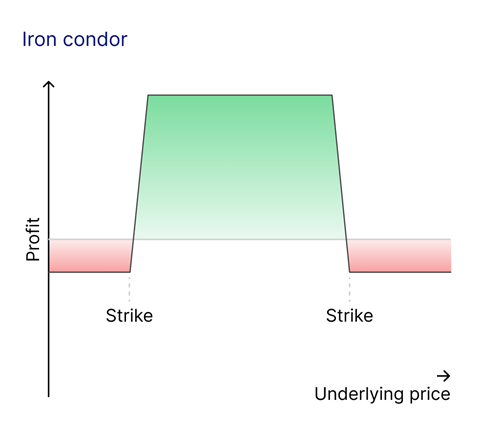
The strategy is called iron condor because the profit and loss chart looks like a bird with wings.

insight articles Iron condor

Example: Crude oil futures

Imagine Crude oil futures are trading at USD 75 per barrel, and you expect the price to remain between USD 70 and USD 80 over the next month. Here’s how you might set up an iron condor:

  • Sell a USD 73 put for a premium of USD 1.50.
  • Buy a USD 70 put for a premium of USD 0.50.
  • Sell a USD 77 call for a premium of USD 1.50.
  • Buy a USD 80 call for a premium of USD 0.50.

Let’s assume each option covers 1,000 barrels of oil (the standard size for a crude oil futures contract).

Premiums collected:

(1.50 + 1.50) × 1,000 = USD 3,000

Premiums paid:

(0.50 + 0.50) × 1,000 = USD 1,000

Net premium (maximum profit):

3,000 - 1,000 = USD 2,000

In this setup, your goal is for Crude Oil prices to stay between USD 73 and USD 77 until the options expire.

Why use an iron condor?

Iron condors are appealing for several reasons:

  • Income generation in quiet markets. This strategy thrives in calm, range-bound markets. By selling options on both sides of the current price, you collect premiums from traders expecting significant price movements. If the market stays within your range, you keep the premium as profit.
  • Defined risk. Unlike more speculative strategies, an iron condor has clearly defined risks. The worst-case scenario occurs if the market moves sharply outside your range. In such cases, your maximum loss is capped at the difference between the strike prices of the spreads, minus the premium collected.
  • Flexibility. Iron condors can be tailored to reflect your market outlook. If you believe the underlying asset’s price is more likely to skew higher or lower, you can adjust the strike prices to create an unbalanced iron condor, favouring one side of the range.

How does it work in practice?

Let’s revisit the Crude oil example to examine potential outcomes:

Scenario 1: Crude oil stays between USD 73 and USD 77

If Crude oil prices remain within this range until expiration, both the put and call spreads expire worthless.

Outcome: You keep the entire USD 2,000 premium as profit.

Scenario 2: Crude oil drops below USD 73

If Crude oil falls to USD 72, the USD 73 put option you sold is in the money, and the buyer exercises it. However, the USD 70 put option you bought limits your loss:

  • Loss on USD 73 put: (USD 73 - USD 72) × 1,000 = USD 1,000
  • Gain on USD 70 put: USD 0 (as the price didn’t drop below USD 70).
  • Net result: USD 1,000 loss - USD 2,000 premium = USD 1,000 profit.

Scenario 3: Crude oil rises above USD 77

Now imagine Crude oil rises to USD 78. The USD 77 call you sold is in the money, but the USD 80 call you bought limits your loss:

  • Loss on USD 77 call: (USD 78 - USD 77) × 1,000 = USD 1,000
  • Gain on USD 80 call: USD 0 (as the price didn’t rise above USD 80).
  • Net result: USD 1,000 loss - USD 2,000 premium = USD 1,000 profit.

Scenario 4: Crude oil breaks far out of range

If Crude oil rises to USD 85 or drops to USD 65, your losses are capped at the width of the spreads (in this case, USD 3 per barrel):

  • Maximum loss: Spread width (USD 3) × 1,000 barrels - Premium (USD 2,000) = USD 1,000 loss.

Comparing iron condors to other strategies

Iron condors are one of many options strategies, each suited to specific market conditions. Let’s explore how iron condors compare to other popular strategies.

Iron condors vs covered calls

  • Covered calls. A directional strategy best suited to bullish markets where prices are expected to rise steadily. You profit from moderate price increases but forgo larger gains if the market surges.
  • Iron condors. A non-directional strategy ideal for range-bound markets. You earn income when the market stays calm, regardless of whether the underlying asset’s price trends up or down within the defined range.

Iron condors vs straddles

  • Straddles. Involve buying a call and a put option at the same strike price, aiming to profit from significant price movements in either direction. They work best in volatile markets, as they rely on large price swings to generate profit. They require substantial upfront investment, as buying both options can be costly.
  • Iron condors. Designed for stable markets, with the goal of collecting premiums from low volatility. While they cap potential profits, they involve lower upfront costs and have defined risk limits.

Iron condors vs protective puts

  • Protective puts. A hedging strategy that involves buying put options to protect against large price declines. They offer security for traders with long positions who fear a sharp drop in the underlying asset’s value. While they limit downside risk, they reduce overall returns because the premium paid for the put acts as a cost.
  • Iron condors. Aim to generate income rather than provide protection. They are better suited for traders who expect stability rather than sharp price moves.

Risks and rewards of iron condors

While iron condors can be an effective tool for range-bound markets, it’s essential to understand their potential rewards and risks before diving in.

Potential rewards

  • Premium collection. The primary appeal of an iron condor is the income generated from selling options. The net premium collected represents your maximum profit, realised when the underlying asset remains within your defined range.
  • Defined risk. Your maximum loss is capped at the width of the spreads, minus the net premium collected. This makes the strategy relatively low-risk compared to others that involve unlimited loss potential.
  • Flexibility. Iron condors can be adjusted to match your market outlook or risk tolerance. For instance, if you believe the market is more likely to drift higher, you can position your range accordingly by shifting the strike prices upward.

Potential risks

  • Limited profit potential. The most you can earn is the net premium collected. While this steady income is appealing, the profits may seem modest compared to the potential losses if the market moves sharply out of range.
  • Market breakouts. Unexpected volatility or large price swings can result in losses. If the underlying asset’s price moves significantly outside your strike price range, the strategy’s capped risk may still lead to notable losses.
  • Complexity. Managing four separate options contracts can be challenging, especially for traders new to options. Mistakes in execution or monitoring the positions could lead to unnecessary losses or reduced profitability.

Is an iron condor right for you?

Iron condors are best suited for traders who:

  • Expect the market to remain range-bound during the options’ lifespan.
  • Prefer strategies with defined risk and reward.
  • Are comfortable managing multiple options positions and understand how to adjust them if needed.

This strategy may not be ideal for highly volatile markets or traders who lack experience with options. However, if you’re confident in your ability to predict market ranges and are comfortable with steady, incremental returns, iron condors can be a valuable addition to your trading toolkit.

A final thought - mastering calm markets

Trading doesn’t always have to feel like a roller coaster. Sometimes, the best opportunities arise from quiet, predictable markets. The iron condor strategy allows you to profit from stability, providing a steady income stream whilst keeping risks manageable.

Whether you’re a seasoned professional or just exploring the world of options, the iron condor offers a practical way to navigate calm markets. It may not carry the mystique of its name, but it can certainly provide a consistent and reliable approach to trading.

Outrageous Predictions 2026

01 /

  • Executive Summary: Outrageous Predictions 2026

    Outrageous Predictions

    Executive Summary: Outrageous Predictions 2026

    Saxo Group

    Read Saxo's Outrageous Predictions for 2026, our latest batch of low probability, but high impact ev...

  • A Fortune 500 company names an AI model as CEO

    Outrageous Predictions

    A Fortune 500 company names an AI model as CEO

    Charu Chanana

    Chief Investment Strategist

    Can AI be trusted to take over in the boardroom? With the right algorithms and balanced human oversi...
  • Dollar dominance challenged by Beijing’s golden yuan

    Outrageous Predictions

    Dollar dominance challenged by Beijing’s golden yuan

    Charu Chanana

    Chief Investment Strategist

    Beijing does an end-run around the US dollar, setting up a framework for settling trade in a neutral...
  • Obesity drugs for everyone – even for pets

    Outrageous Predictions

    Obesity drugs for everyone – even for pets

    Jacob Falkencrone

    Global Head of Investment Strategy

    The availability of GLP-1 drugs in pill form makes them ubiquitous, shrinking waistlines, even for p...
  • Dumb AI triggers trillion-dollar clean-up

    Outrageous Predictions

    Dumb AI triggers trillion-dollar clean-up

    Jacob Falkencrone

    Global Head of Investment Strategy

    Agentic AI systems are deployed across all sectors, and after a solid start, mistakes trigger a tril...
  • Quantum leap Q-Day arrives early, crashing crypto and destabilizing world finance

    Outrageous Predictions

    Quantum leap Q-Day arrives early, crashing crypto and destabilizing world finance

    Neil Wilson

    Investor Content Strategist

    A quantum computer cracks today’s digital security, bringing enough chaos with it that Bitcoin crash...
  • Taylor Swift-Kelce wedding spikes global growth

    Outrageous Predictions

    Taylor Swift-Kelce wedding spikes global growth

    John J. Hardy

    Global Head of Macro Strategy

    Next year’s most anticipated wedding inspires Gen Z to drop the doomscrolling and dial up the real w...
  • SpaceX announces an IPO, supercharging extraterrestrial markets

    Outrageous Predictions

    SpaceX announces an IPO, supercharging extraterrestrial markets

    John J. Hardy

    Global Head of Macro Strategy

    Financial markets go into orbit, to the moon and beyond as SpaceX expands rocket launches by orders-...
  • Britain’s Great EU Backdoor Return

    Outrageous Predictions

    Britain’s Great EU Backdoor Return

    Neil Wilson

    Investor Content Strategist

    Faced with rolling fiscal, economic, trade and political crises the UK government sneaks back into t...
  • Despite concerns, U.S. 2026 mid-term elections proceed smoothly

    Outrageous Predictions

    Despite concerns, U.S. 2026 mid-term elections proceed smoothly

    John J. Hardy

    Global Head of Macro Strategy

    In spite of outstanding threats to the American democratic process, the US midterms come and go cord...

This content is marketing material. 

None of the information provided on this website constitutes an offer, solicitation, or endorsement to buy or sell any financial instrument, nor is it financial, investment, or trading advice. Saxo Capital Market Ltd. (SCML) provides execution-only services, with all trades and investments based on self-directed decisions. Analysis, research, and educational content is for informational purposes only and should not be considered advice or a recommendation.

SCML content may reflect the personal views of the author, which are subject to change without notice. Mentions of specific financial products are for illustrative purposes only and may serve to clarify financial literacy topics. Content classified as investment research is marketing material and does not meet legal requirements for independent research.

SCML partners with companies that provide compensation for promotional activities conducted on its platform. Some partners also pay retrocessions contingent on clients investing in products from those partners. 

While SCML receives compensation from these partnerships, all educational and research content remains focused on providing information to clients.

Before making any investment decisions, you should assess your own financial situation, needs, and objectives, and consider seeking independent professional advice. SCML does not guarantee the accuracy or completeness of any information provided and assumes no liability for any errors, omissions, losses, or damages resulting from the use of this information.

Please refer to our full disclaimer and notification on non-independent investment research for more details.

Saxo
40 Bank Street, 26th floor
E14 5DA
London
United Kingdom

Contact Saxo

Select region

United Kingdom
United Kingdom

Trade Responsibly
All trading carries risk. To help you understand the risks involved we have put together a series of Key Information Documents (KIDs) highlighting the risks and rewards related to each product. Read more
Additional Key Information Documents are available in our trading platform.

Saxo is a registered Trading Name of Saxo Capital Markets UK Ltd (‘Saxo’). Saxo is authorised and regulated by the Financial Conduct Authority, Firm Reference Number 551422. Registered address: 26th Floor, 40 Bank Street, Canary Wharf, London E14 5DA. Company number 7413871. Registered in England & Wales.

This website, including the information and materials contained in it, are not directed at, or intended for distribution to or use by, any person or entity who is a citizen or resident of or located in the United States, Belgium or any other jurisdiction where such distribution, publication, availability or use would be contrary to applicable law or regulation.

It is important that you understand that with investments, your capital is at risk. Past performance is not a guide to future performance. It is your responsibility to ensure that you make an informed decision about whether or not to invest with us. If you are still unsure if investing is right for you, please seek independent advice. Saxo assumes no liability for any loss sustained from trading in accordance with a recommendation.

Apple, iPad and iPhone are trademarks of Apple Inc., registered in the U.S. and other countries. App Store is a service mark of Apple Inc. Android is a trademark of Google Inc.

©   since 1992